Dive Light for Night Diving: 7 Best Picks for Divers (2026)
Compare seven dive lights for night diving, from compact backup lights to high-lumen primary lights. Learn what lumens, beam angle and IPX8 ratings mean for you
 By scubawomen editorial team
Updated November 7, 2026

 By Violet Wallace
As an Amazon Associate I earn from qualifying purchases. This page may contain affiliate links.
Choosing a dive light for night diving comes down to three things: how much light you need, how long it has to last, and how it fits into your gear setup. Night dives are a different environment from daytime dives. Colors disappear, visibility shrinks to the edge of your beam, and marine life behaves differently. A reliable light is what keeps you oriented, lets you signal your buddy, and helps you see what is around you. The picks below were selected by comparing published specifications, brand reputation and common owner feedback, with attention to output, beam pattern, waterproof rating, runtime and charging method. Nothing here is based on our own testing, so check specs against your planned dive type before buying.
Our Top Picks
Quick Comparison
| Product | Best for | Key feature |
|---|---|---|
| WINDFIRE Dive Light Scuba Diving Flashlight | Beginners and backup lighting | Simple three-mode operation with a power indicator |
| Wurkkos DL30 Dive Light | Night dives and cave-adjacent diving | 3600 lumen rechargeable output |
| XTAR D26 Scuba Diving Light | Focused beam work on night dives | 7 degree narrow beam with 2800 lumens |
| ORCATORCH D530 Scuba Dive Light | Long-range visibility and cave diving | 7 degree narrow beam with IP68 rating |
| HECLOUD Dive Light 2 Pack | Buddy teams wanting a spare | Two-light set with wristband and lanyard |
| Wurkkos DL05 Scuba Dive Light | Long dives needing extended runtime | 6000 lumens with 14 hour runtime claim |
| HECLOUD 3000LM Diving Flashlight | Divers wanting a compact high-output light | XHP70 LED with rugged aluminum body |
WINDFIRE Dive Light Scuba Diving Flashlight Bright Underwater Flashlight
WINDFIRE Dive Light Scuba Diving Flashlight Bright Underwater Flashlight | 3 Modes, Power Indicator, IPX8 Waterproof, Built-in Battery Non-detachable, Long-lasting, Night Diving & Snorkeling
This light suits newer divers and anyone who needs a dependable backup for night dives. Its straightforward controls make it easy to use with cold hands or a gloved grip.
Key specs For a deeper look, 7 Best Dive Lights with Laser Options for Night and Cave Diving (2026) covers this in detail.
- Three light modes
- Power indicator
- IPX8 waterproof rating
- Built-in, non-detachable battery
Pros
- Simple mode switching suited to beginners
- Power indicator helps you track remaining charge before a dive
- IPX8 rating covers typical recreational depths
Cons
- Non-detachable battery limits swapping or replacing it on the go
- Output is modest compared with high-lumen primary lights
Wurkkos DL30 Dive Light Rechargeable 3600 Lumens Bright Scuba Diving Light

Wurkkos DL30 Dive Light Rechargeable, 3600 Lumens Bright Scuba Diving Light | IPX-8 Waterproof Flashlight, 3 Modes, 100m Underwater Lights for Night Diving Cave Snorkeling Submersible Safety Lights
This is a fit for divers who want strong output for night diving and who prefer a rechargeable light. Its listed 3600 lumens give a wide, bright field of view for spotting marine life.
Key specs
- 3600 lumens listed output
- Three modes
- IPX-8 waterproof rating listed for 100 meters
- Rechargeable
Pros
- High listed output for wide-area lighting
- Rechargeable design reduces battery replacement
- Three modes give flexibility between bright and conserving light
Cons
- Bright settings drain power quickly, so plan runtime
- Its size and weight are larger than compact backup lights
XTAR D26 Scuba Diving Light 2800 Lumens Super Bright Underwater Flashlight

XTAR D26 Scuba Diving Light, 2800 Lumens Super Bright Underwater Flashlight with 7 Degrees Narrow Beam and Power Indicator,Scuba & Snorkeling Safety Dive Lights for Night Diving
This light is aimed at divers who want a focused beam for looking into crevices, reefs and wrecks at night. The 7 degree narrow beam concentrates output for distance rather than broad coverage.
Key specs
- 2800 lumens listed output
- 7 degree narrow beam
- Power indicator
- Designed for scuba and snorkeling
Pros
- Narrow beam reaches farther for spotting distant subjects
- Power indicator helps monitor battery level
- Suitable for both scuba and snorkeling use
Cons
- Narrow beam gives less peripheral light, which can feel tunnel-like
- Better as a focused light than as a general-purpose primary
ORCATORCH D530 1500 Lumens Scuba Dive Light with 6500K Cold White Light

ORCATORCH D530 1500 Lumens Scuba Dive Light with 6500K Cold White Light | 3 Modes (High/Low/SOS), 7° Narrow Beam for Long Range Visibility, IP68 Waterproof, 150m Depth Rating, for Night & Cave Diving
This light fits divers who need long-range visibility, including cave and wreck work at night. The listed IP68 rating and 150 meter depth rating make it suitable for deeper, more demanding conditions.
Key specs
- 1500 lumens listed output
- 6500K cold white light
- Three modes including high, low and SOS
- 7 degree narrow beam
- IP68 waterproof rating, 150 meter depth rating
Pros
- Narrow beam and cold white output help with long-range viewing
- SOS mode adds a signaling option
- Depth rating covers more demanding dives
Cons
- Narrow beam requires deliberate scanning on open-water night dives
- Not all owners find cold white light comfortable for marine life viewing
HECLOUD Dive Light IPX8 Waterproof Diving Flashlight 3 Modes 2Pack
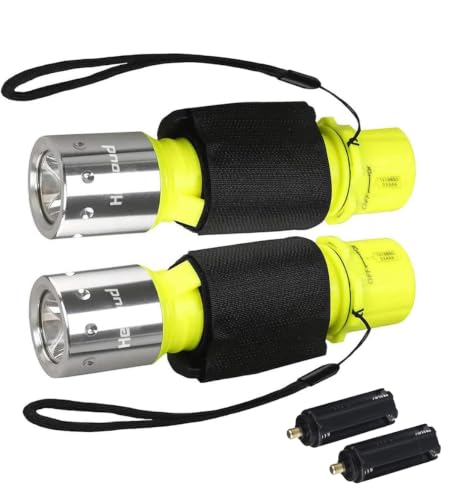
HECLOUD Dive Light IPX8 Waterproof Diving Flashlight 3 Modes 2Pack | T6 LED Bulb, High Lumens, Shockproof Plastic, 60000Hrs Lifespan, Wristband & Lanyard Included, Night Diving & Snorkeling
This two-pack suits buddy teams who want a spare light for each diver. Having a second light on hand is a practical way to cover a failure during a night dive.
Key specs
- Two-pack
- Three modes
- T6 LED bulb
- IPX8 waterproof rating
- Wristband and lanyard included
Pros
- Two lights give built-in redundancy for buddy pairs
- Wristband and lanyard make lights easy to secure
- Simple three-mode design is easy to operate
Cons
- T6 output is lower than the high-lumen options in this list
- Plastic body feels lighter than metal-housing lights
Wurkkos DL05 Scuba Dive Light 6000LM 14H Runtime Underwater Flashlight

Wurkkos DL05 Scuba Dive Light 6000LM, 14H Runtime Underwater Flashlight | IPX8 Waterproof 100M Rechargeable Submersible Torch with Type-C, Handheld Scuba Diving Light for Snorkeling, Night Diving
This light is a good match for long night dives where runtime matters as much as brightness. The listed 14 hour runtime is a manufacturer claim, and real runtime will depend on the mode you use.
Key specs
- 6000 lumens listed output
- 14 hour runtime (manufacturer claim)
- IPX8 waterproof rating listed for 100 meters
- Rechargeable via Type-C
Pros
- High listed output for wide, bright coverage
- Type-C charging is convenient for modern devices
- Long runtime claim suits extended dives
Cons
- Runtime claims vary with mode, so verify on a test run at home
- Peak output may run warm during extended use
HECLOUD 3000LM IPX8 Waterproof Diving Flashlight XHP70 LED

HECLOUD 3000LM IPX8 Waterproof Diving Flashlight 3 Modes Scuba Light | XHP70 LED, 100Ft Underwater Visibility, Rugged Aluminum Alloy, Compact Portable, Ideal For Diving Fishing Camping Gift
This compact high-output light fits divers who want strong light without a bulky body. The rugged aluminum alloy construction is a useful feature for a light that will see rough handling.
Key specs
- 3000 lumens listed output
- XHP70 LED
- Rugged aluminum alloy body
- Three modes
- IPX8 waterproof rating
Pros
- High output in a compact, portable body
- Aluminum alloy housing is sturdier than plastic designs
- Works for diving and other outdoor uses
Cons
- Listed “100Ft visibility” is a manufacturer claim that depends on water clarity
- Its general-purpose design may not suit specialized cave work
Buying Guide
A dive light for night diving has to do more than shine. It must hold up to salt water, last for the length of your dive, and let you see clearly without blinding your buddy or washing out the reef. Use the criteria below to narrow the list before you compare individual models.
Selection Criteria
Start with where and how you dive. A light for shallow reef dives has different needs than one for wrecks, caves or deeper sites. Consider how long your typical dive lasts, whether you dive alone or with a buddy, and whether you need a primary light, a backup, or both. Good dive lights are used as redundant systems, so a single light is rarely enough for serious night work.
Important Features
- Lumens: Higher lumen output gives a brighter, wider field of view. Manufacturers often list lumen ratings under different test conditions, so treat them as a rough guide rather than a precise comparison.
- Beam angle: A wide beam lights up a broad area for general viewing. A narrow beam, such as 7 degrees, reaches farther and is useful for scanning open water or looking into crevices.
- Color temperature: Cooler white light (higher Kelvin) can look brighter in the water, while warmer light may render colors more naturally. Owners’ preferences vary.
- Waterproof rating: Look for IPX8 for submersible use. IP68 is also common. Check the stated depth rating against your diving depth.
- Battery type: Rechargeable lights reduce replacement costs over time. Non-detachable batteries are simpler to seal but harder to swap in the field.
- Modes: A low mode extends runtime, while a high mode is for signaling or wide illumination. A flashing or SOS mode can help with signaling.
- Mounting and retention: A wrist strap, lanyard or bracket keeps the light secure and reachable.
Specs to Check
- Confirm the waterproof rating and depth rating match your planned dives.
- Check the listed runtime at the mode you actually plan to use, not only the maximum runtime.
- Note whether the battery is rechargeable and how it charges.
- Look at beam angle to decide between flood and spot coverage.
- Check the body material. Aluminum alloy is generally more robust than plastic, but heavier.
Choosing by Need
- New divers and backup use: A compact, simple light with a power indicator is easier to manage.
- Night reef and general viewing: A brighter, wider-beam light gives better overall coverage.
- Cave, wreck or long-range work: A narrow-beam light with high output and a strong depth rating suits focused scanning.
- Buddy teams: Two lights, or a primary and a spare, give you a plan if one fails.
- Long dives: Prioritize runtime at your chosen mode and a reliable charging system.
Things to Watch Out For
- Lumen claims are often measured under ideal conditions and may not match what you see in murky water.
- Runtime figures depend on mode and battery age. Test a fully charged light at home before a trip.
- Seals and O-rings need regular rinsing with fresh water and inspection for debris or wear.
- Never assume a light is safe at depth based on the listing alone. Confirm the rating and stay within your training limits.
- Diving is a physically and medically demanding activity. Consult a physician or a certified dive professional before diving, especially if you have health concerns.
FAQ
How many lumens do I need for a dive light for night diving?
For casual reef dives, a few hundred to around 1000 lumens can be enough in clear water. For wrecks, caves or murky conditions, many divers prefer higher output. Because lumen ratings vary by test method, compare lights by the mode you will use and by the beam angle.
Do I need a backup dive light?
Yes, for night diving a backup is a standard safety practice. Many dive training agencies recommend carrying a primary light and a backup, so you can see and signal if one fails.
What does IPX8 mean on a dive light?
IPX8 means the light is rated for continuous submersion beyond 1 meter. The specific depth and duration are set by the manufacturer, so check the stated depth rating against your planned dives.
Is a narrow beam or a wide beam better for night diving?
A wide beam is better for general viewing and keeping your bearings. A narrow beam reaches farther and is useful for spotting distant objects or looking into openings. Many divers carry one of each or choose a model with adjustable focus.
Should I choose a rechargeable or battery-powered dive light?
Rechargeable lights reduce ongoing battery costs and can be convenient for frequent divers. Battery-powered lights are simple to replace in the field. Your choice depends on how often you dive and how you prefer to manage power.
How do I keep my dive light working well?
Rinse the light in fresh water after every dive, inspect the O-ring and seals, and store it charged and dry. Follow the manufacturer’s maintenance instructions, and replace seals that show wear.
What color light is best for night diving?
White light is the most common choice because it shows the broadest range of colors. Some divers prefer cooler tones for brightness in the water. Warm light can help with color rendering in shallow reef settings. Try to see the light in your own environment if possible.
Conclusion
For most divers, the right dive light for night diving is one that matches your dive type and gives you a dependable backup plan. A compact, simple light suits beginners and backup use. A high-output, wide-beam light fits general night reef dives. A narrow-beam, high-output light with a strong depth rating suits cave, wreck and long-range work. Buddy teams should consider a two-pack or a primary and spare combination. Verify waterproof ratings, runtime at your chosen mode, and charging method before you buy, and consult a certified dive professional if you are unsure which light fits your training and diving conditions.
Related reading
- 8 Best Scuba Dive Light Picks for Every Night Dive (2026)
- Dive In Bag Backpack: 8 Best Dive Bags for Travel and Boat Diving (2026)
- Dive Computer Smart Watch: How to Choose One for Diving (2026)

About Violet Wallace
Violet writes about scuba gear for women. Each guide starts with research into how products are built and what owners report after months of use, and is revised when better options appear.
About the author

scubawomen editorial team writes reviews and buying guides for Scuba Women.